
- Maturity
- Pilot, running at one customer site in a limited scope; no results published yet
- Where
- A life-sciences manufacturer’s warehouse in California
- Hardware
- PAL Robotics STOCKBOT autonomous mobile robot with an on-board RFID reader
- InThing software
- EAI-Bridge (upload connector) · Visium (locations, floor plans, inventory) · InFlow
The problem
Many warehouses already put RFID tags on their products, yet still send people to count the racks by hand every day to keep inventory accurate. It is slow, repetitive work, and the moment the count ends, it starts going out of date.
What the robot does
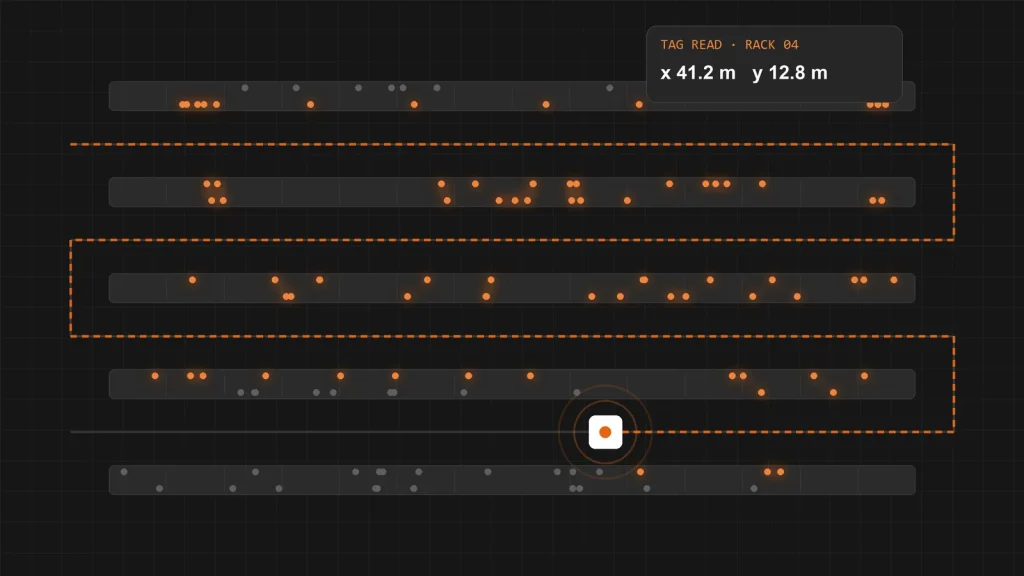
STOCKBOT drives the aisles on its own, maps the building and reads every RFID tag it passes. At the end of each run it knows which tags it saw and roughly where, an X/Y position in its own map of the warehouse.
What InThing added
- A secure upload connector in EAI-Bridge. After each run the robot signs in and uploads its list of tag reads. No one has to copy files around.
- Turning reads into inventory facts. Each read becomes an observation in Visium, so the item’s last-seen time and place update automatically.
- From robot coordinates to real locations. Visium places every X/Y point on the customer’s floor plan and resolves it to a logical location, an aisle, a rack, a zone, that people and the ERP understand.
- One view with everything else. Robot reads sit next to fixed readers and handhelds, so the warehouse has one inventory picture regardless of how a tag was read.
What we have learned so far
- Maps have to agree. The robot’s map and the customer’s floor plan use different origins and scales, we even found one axis flipped. Alignment is now part of commissioning.
- The environment matters. How accurately a tag can be located depends on the layout, rack materials and how densely tags are packed, so speed and reader settings are tuned on site.
- IT access is the real critical path. Getting a robot onto a customer network securely took longer than the software integration itself.
What’s next
The pilot covers the lower rack levels; reading the upper levels with readers mounted on forklifts is part of the plan. We will publish results when the customer is ready, until then, this stays labelled as a pilot.
Interested in autonomous inventory for your warehouse or data center? Talk to us.