
InVault use case
Equipment tracking for labs, IT and fixed assets
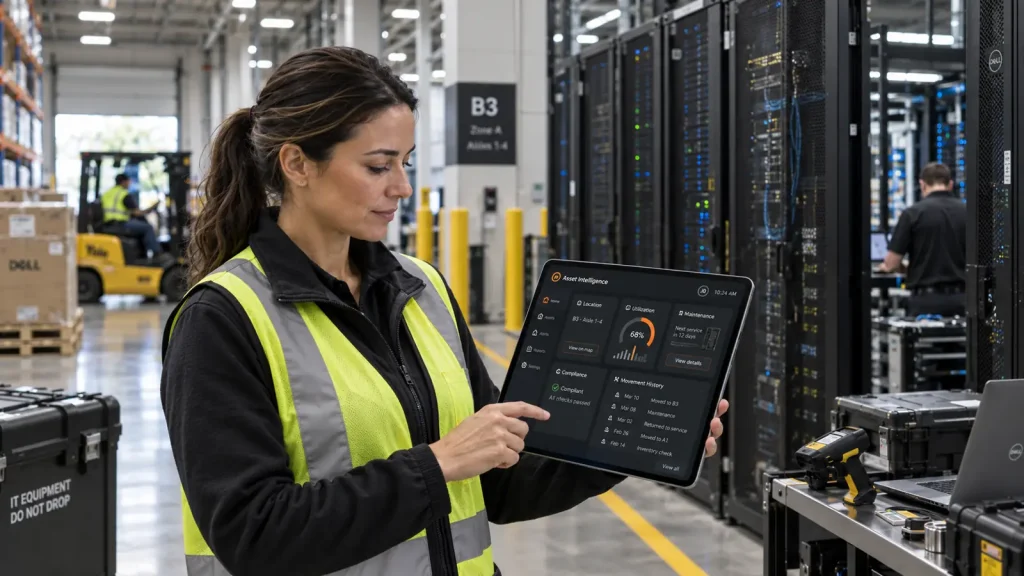
InVault handles equipment tracking and RFID asset tracking for the expensive things that move around: lab instruments, test gear, servers, laptops, fixed assets and voting machines. You see where each one is, who has it and when it is due for calibration, without sending anyone on a search.
The problem
Expensive equipment shouldn’t be hard to find.
Shared instruments and IT hardware are always “somewhere”. People lose an hour looking, a project waits, and someone orders a duplicate because nobody can prove the first one exists.
Then the audit comes and the register and the floor disagree. A calibration-critical meter gets used past its due date. A spectrum analyzer sits in a cupboard while the team next door buys a new one.
- Lab & R&D
- Microscopes, centrifuges, analyzers, test and measurement equipment, prototypes
- IT & data center
- Servers, switches, storage, laptops, phones, peripherals
- Fixed assets
- Office and plant equipment, racks and machinery under SOX or ISO control
- Public sector
- Voting equipment, evidence and other chain-of-custody items
What changes
What equipment tracking changes day to day
- Search for any asset, see where it was last seen, then walk straight to it with the Geiger locate mode on a handheld
- Audit a room in minutes instead of days, with a list of what is missing and what is in the wrong place
- Calibration and maintenance alerts tied to the physical instrument, with the history ready for QA
- Reservations and check-outs that record who has each item and when it is due back
In earlier InThing deployments, teams inventoried a room full of assets in under two minutes and scanned a 20,000 sq ft data center in about 30 minutes, at less than $1 per asset per year. In labs, more sharing and better utilization cut annual spend across all equipment categories by 15%.
How it works
How RFID asset tracking works with InVault
- CaptureTags go on the assets. Fixed readers watch doorways, racks and portals, BLE gateways cover shared spaces, and a handheld sweep handles the rest.
- UnderstandTrapeze places every read on one digital floor plan, keeps the movement history and reconciles it against your asset register.
- ActVisium gives you visual search, Geiger locate, reservations and check-outs, calibration alerts and audit reports on web, mobile and self-service stations.
Asset classes we cover
Four kinds of capital equipment, one register.
Each of these used to have its own page on our site. They share the same software, so they now live here together.
IT asset tracking and data-center assets
Servers, switches, storage arrays, laptops and phones change hands and rooms constantly. Readers at data-center doors and portals log every move, so a server that leaves the cage without a ticket raises an alert. A full audit of a 20,000 sq ft data center takes about 30 minutes with a handheld, and EAI-Bridge keeps ServiceNow, SAP or IBM Maximo current.
Lab equipment tracking
Microscopes, analyzers, test and measurement gear, small tools, kits and prototypes. Departments, projects and grants can reserve shared instruments and check them in and out, calibration cycles run on the real asset, and you get desk, bench and rack-level inventory. Lab customers report 15% lower annual spend across all categories of lab equipment.
Fixed asset audit
Capitalized assets audited for SOX, ISO and internal controls over financial reporting without a month of spreadsheets. Cycle counts run at 99% accuracy, a single asset can be located in under a minute, and periodic movement reports show what left its assigned room. Colleges use parent-child separation reports to see when a component leaves its main unit.
Voting equipment tracking (VETS)
VETS keeps a chain of custody for voting machines, ballot boxes, media kits, hopper sacks and memory backups. Philadelphia has used it since the November 2020 presidential election, on the Azure Government cloud, with a Geiger locate mode for finding kits and accessories in minutes. Deployment takes less than a week.
Workflows this use case improves
Part of the InVault asset lifecycle.
Maintenance & calibration
Due dates, overdue alerts and service history per instrument.
Workflow details
Reservations & checkouts
Shared equipment booked, issued and returned, with custody recorded.
Workflow details
Alerts & reports
Exceptions surface themselves.
- Not seen since…
- Left the building
- Calibration due / overdue
- Reserved but not returned
- Asset idle time
- Audit discrepancies
Technology fit
The right sensor for each asset class.
- UHF RFIDBulk audits of rooms and racks with handhelds, plus automatic reads at doors and portals.
- Bluetooth LEContinuous zone presence for shared instruments that move often.
- UWBExact position for very high-value or frequently relocated equipment.
- Barcode & NFCLow-cost identity and tap-to-confirm check-outs.
Proof
Capital assets under control.
City of Philadelphia
Philadelphia swapped pen-and-paper tracking of voting equipment for Zebra RFID readers and InThing’s VETS software. Every machine has a chain of custody from the warehouse to the polling place and back.
3,500voting machines across 720 polling locations
50%lower equipment reconciliation cost per election cycle
Applied Materials
The Metal Deposition Products group made its lab equipment, components and consumables visible with RFID and BLE. Six hundred assets across two buildings were inventoried in two hours.
60 → 5 minto find a high-value part, with 99% accuracy
$1Min annual cost savings
By vertical
Where capital asset tracking matters most.
Government & Education
Voting equipment, public fixed assets and campus equipment.
Government & Education
Life Sciences & Healthcare
Calibration-critical lab instruments and hospital equipment.
Life Sciences & Healthcare
Questions buyers ask
Equipment tracking FAQ
Do we need to replace our asset management or ERP system?
No. InVault keeps your existing system of record accurate. EAI-Bridge publishes locations, audits and exceptions into SAP, Oracle, ServiceNow, IBM Maximo and similar systems.
RFID or Bluetooth: which is better for equipment?
It depends on how the asset moves and how often you need to know where it is. Passive RFID suits audits and doorway reads, and the tags cost very little. Bluetooth LE gives continuous room-level presence for shared equipment. Many sites use both.
Can we start with one lab or one site?
Yes. Trapeze runs on a single server for a pilot and scales to high-availability clusters for an enterprise rollout. Most customers start RFID asset tracking in one room or with one asset class, and agree a before-and-after number up front.
Related reading
More on asset tracking and audits
-
Lab note
Visium AI: ask your operation anything, in plain English
“Where was forklift 01 last seen?” Visium AI answers from your live data, respects every permission and changes nothing without your approval.…
-
Blog
SLED Asset Accountability: How to Replace Manual Audit Chaos With Continuous Assurance
Annual hallway audits can’t keep up anymore. Learn how SLED teams borrow continuous assurance from finance and catch asset issues in week…
-
Blog
What Is Asset Intelligence and How Is It Different from Asset Tracking?
Asset tracking tells you where something is. Asset intelligence tells you what is happening around it, why it matters, and what to…
Part of InVault
One asset tracking application for every asset class.
Capital assets and equipment is one of four InVault use cases, alongside plant tools and MHE, returnable items, and documents and textbooks. All four run on the same InThing platform.
- Related use cases
- Plant tools & MHE · Returnable items
- Platform
- Trapeze · Visium · EAI-Bridge
Find your asset blind spots
Bring your hardest asset class.
We’ll map where your equipment really is, which technology fits, and what your next audit could look like.